
The modeling industry isn’t what most people think it is. It’s not just tall women walking down runways in designer clothes, and it’s definitely not as glamorous as reality TV makes it look. But it’s also not impossible to break into, and it’s way more diverse than it used to be.
Today’s modeling world includes everything from traditional fashion shows to Instagram collaborations, fitness campaigns to TV commercials. Models work in studios, on location, and even from their own homes. Some are signed to major agencies in New York or Paris, while others build successful freelance careers from smaller cities.
This guide will walk you through exactly how the modeling industry works. You’ll learn who the key players are, how models actually get jobs and get paid, what types of modeling exist, and how to spot scams before they waste your time or money. Whether you’re thinking about modeling as a career or just curious about how it all happens behind the scenes, this is your starting point.
What Is the Modeling Industry?
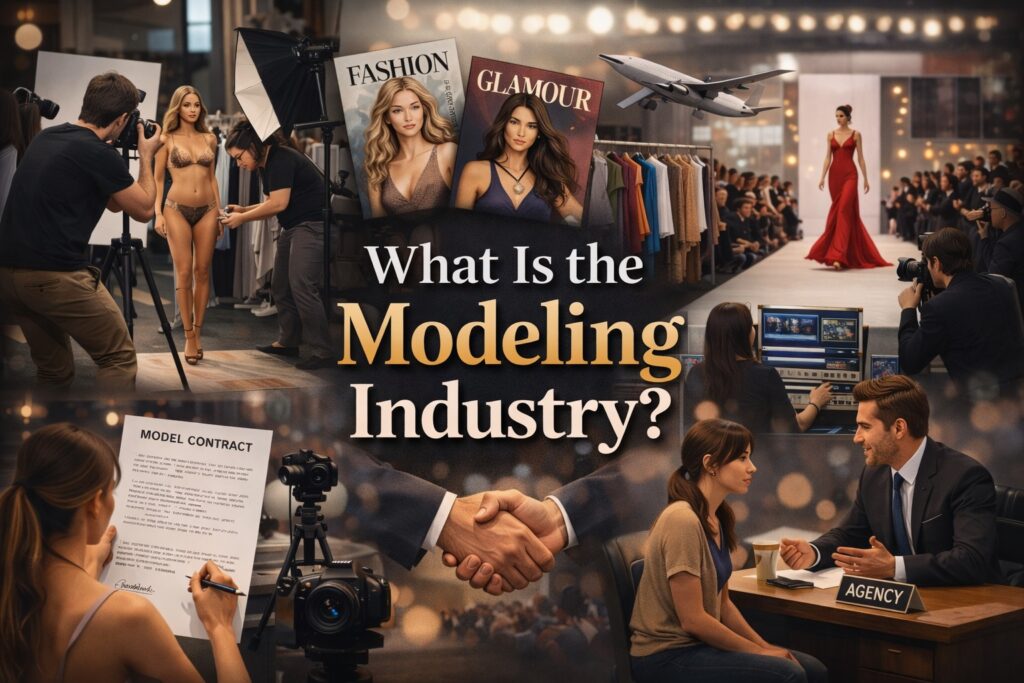
The modeling industry is the business of hiring people to represent products, brands, ideas, or artistic visions through their appearance. Models are essentially visual communicators. They help sell clothing, promote lifestyles, tell stories in magazines, or bring a designer’s creative vision to life on a runway.
The modeling industry is estimated to be worth USD 13–14 billion, driven mainly by commercial advertising, digital campaigns, and e-commerce.
Models work in fashion shows, photo shoots, commercials, catalogs, social media campaigns, trade shows, and even virtual environments. They might spend one day modeling wedding dresses for a bridal magazine and the next promoting athletic wear for an Instagram ad.
The industry connects several worlds: fashion, advertising, media, entertainment, and increasingly, digital platforms. A fashion designer needs models to showcase their collection. An advertising agency needs models to make their client’s product look appealing. A magazine needs models to create compelling visual stories. Social media platforms need models to create content that drives engagement.
Traditional modeling used to mean signing with an agency, building a portfolio, and hoping to book runway shows or magazine editorials. Modern modeling includes all of that, but it also includes influencer-style content creation, digital modeling for video games or virtual fashion, and direct-to-brand relationships that bypass agencies entirely.
Some models even exist only as AI-generated images now, which is changing the industry in ways we’re still figuring out. But despite all these changes, the core purpose remains the same: using human appearance and expression to communicate visually.
How Does the Modeling Industry Work?
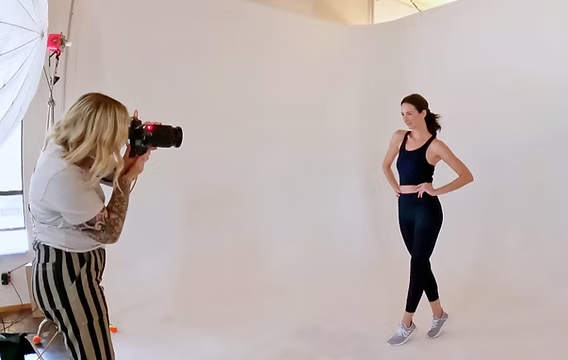
Understanding how the modeling industry actually operates will help you navigate it smarter, whether you’re trying to break in or just curious about the process.
The Key Players in the Modeling Industry
Models are the talent. They’re the ones who show up to castings, stand in front of cameras, walk runways, and bring creative concepts to life. But they’re just one piece of a much bigger puzzle.
Modeling agencies act as representatives and managers for models. They handle bookings, negotiate contracts, manage schedules, collect payments, and guide career development. Good agencies have relationships with clients and can open doors that would otherwise stay closed. They typically take a commission (usually 20% in the U.S.) from each job they book for you.
Clients and brands are the ones paying for modeling work. This could be a clothing company launching a new line, an advertising agency working on a campaign, a magazine planning a photoshoot, or a small business needing product photos. They’re the ones with the budget and the creative vision.
Designers create the clothing, accessories, or products that models wear or promote. In fashion modeling, designers are especially important because landing shows or campaigns with respected designers can significantly boost a model’s career.
Photographers and creative teams include photographers, stylists, makeup artists, hair stylists, art directors, and creative directors. They’re responsible for the actual execution of the visual work. A good photographer can make an average model look amazing, and a great model can bring an average concept to life.
Step-by-Step: How a Modeling Job Happens
Understanding this process helps you know what to expect and what’s normal versus what’s a red flag.
1. Client briefs an agency: A brand or client contacts a modeling agency (or multiple agencies) with a project. They explain what they need: the type of model, the look they’re going for, the dates, the usage, and the budget.
2. Agency submits models: The agency reviews their roster and submits models who fit the brief. This usually means sending comp cards (a model’s stats and photos) or digital portfolios to the client.
3. Casting or direct booking: Sometimes clients directly book a model based on their portfolio. Other times, they hold a casting where multiple models come in to be evaluated in person or via video. Castings can involve trying on clothes, walking, posing, or just meeting the team.
4. Contract and usage agreement: Once a model is selected, the agency and client negotiate and sign a contract. This covers the day rate, usage rights (where and how long the images can be used), travel arrangements, and other details. Usage is crucial because a photo used only on a website is worth less than one used in a national TV campaign.
5. Shoot, show, or campaign: This is the actual work day. For a photoshoot, this might be 4-8 hours in a studio. For a runway show, it could be a few hours of rehearsal and the show itself. For a commercial, it might be a full day or multiple days of filming.
6. Payment and usage period: After the work is completed, the client pays the agency, which then pays the model (minus commission). Payment timing varies but often takes 30-90 days. The usage agreement specifies how long the client can use the images, and in some cases, models can earn additional fees if usage is extended.
Who Is the Modeling Industry For?

Image Credit: Skylar Modeling
One of the biggest misconceptions about modeling is that it’s only for a very specific type of person. That used to be more true than it is now.
Aspiring models with no experience can absolutely enter the industry. Everyone starts somewhere, and many successful models were discovered with zero prior experience. What matters more than experience is having the right look for current market demands, a professional attitude, and the willingness to learn.
Students and part-time professionals often find modeling flexible enough to fit around other commitments. Many models treat it as a side income while pursuing education or other careers. Some cities have more opportunities for part-time work than others, but commercial and promotional modeling especially can work around other schedules.
People of different body types, ages, and backgrounds are more welcome in today’s modeling industry than ever before. Plus-size modeling is a significant market. Mature models (over 40, 50, even 60+) are increasingly sought after. Petite models, diverse ethnicities, models with disabilities, and models who don’t fit traditional beauty standards all have opportunities that didn’t exist a generation ago.
Creators transitioning into modeling find that their existing social media presence can be an asset. Brands increasingly want models who can also create content and have their own engaged audiences. If you already know how to work with a camera and have built a following, you have skills that traditional models are now trying to learn.
Those interested in fashion, media, or creative careers might find modeling a useful entry point or complementary skill. Working as a model teaches you how photoshoots operate, how creative teams collaborate, and how the fashion and advertising industries function from the inside.
Here’s what’s important to understand: you don’t need to be 5’10”, a size zero, or 18 years old to model. Those requirements apply to high fashion runway modeling, which is just one small segment of the industry. Commercial modeling, which makes up the bulk of paid work, seeks people who look like regular consumers. Brands selling products to 40-year-old moms want models who look like 40-year-old moms. Companies selling athletic wear in extended sizes need models who wear those sizes.
The question isn’t whether modeling is “for you” based on your appearance. The question is whether there’s a market demand for your particular look, and whether you’re willing to approach it as a real business.
Types of Modeling in the Industry
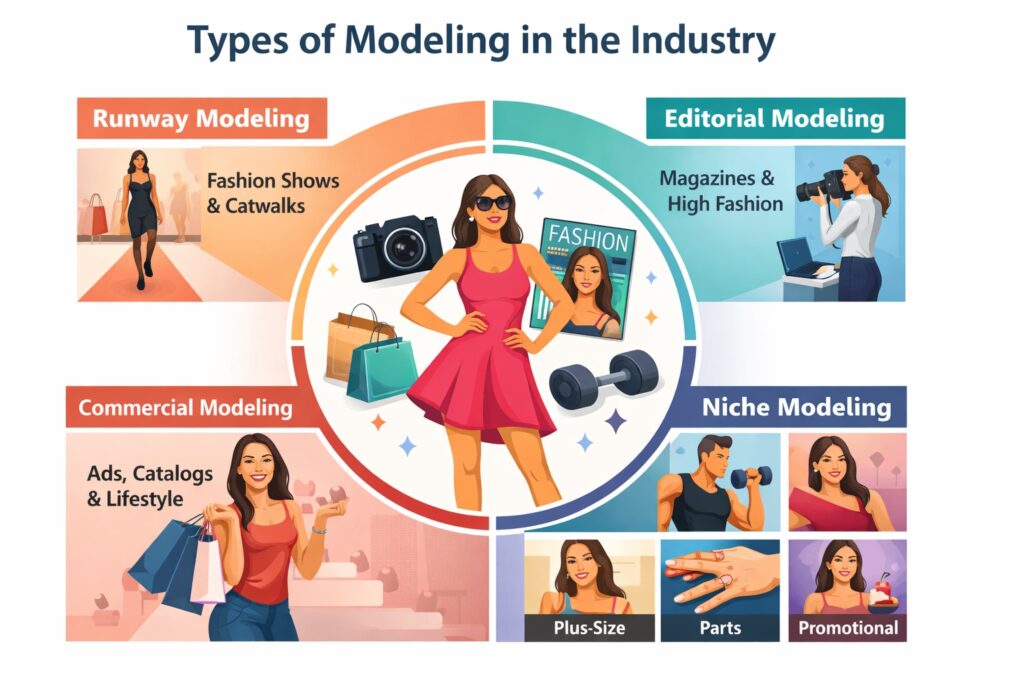
The modeling industry isn’t one thing. It’s dozens of different markets with different requirements, pay scales, and career paths.
Runway Modeling
Runway modeling means walking in fashion shows for designers and brands. This is the category most people picture when they think of modeling, but it’s actually one of the smallest segments by number of jobs.
Runway models showcase clothing collections during fashion weeks and designer presentations. The focus is on the clothes, so models are expected to walk with confidence and consistency without distracting from the garments.
Height and measurement expectations for runway work are the most strict in the industry. Women are typically expected to be 5’9″ to 6’0″ tall and wear sample sizes (usually size 0-4). Men are usually 5’11” to 6’2″ with a lean build. These requirements exist because designers create sample garments in these sizes, and fashion shows move too fast to alter clothing for each model.
Runway work often doesn’t pay as much as you’d think. Models might earn a few hundred to a few thousand dollars per show, but many fashion shows (especially during fashion week) pay little or nothing because the exposure is considered valuable for career building.
Editorial Modeling
Editorial modeling is the work you see in magazines, fashion publications, and artistic photoshoots. These projects prioritize creativity, storytelling, and aesthetic vision over selling specific products.
Editorial work is prestigious and great for building a portfolio, but it’s often the lowest-paid type of modeling. Many editorial shoots, especially in fashion magazines, pay very little or only offer “trade” (free photos for your portfolio instead of money). The value comes from the credibility and visibility of being published in respected magazines.
Editorial models need to be expressive and versatile in front of the camera. The work is more artistic and conceptual than commercial modeling, and photographers and creative directors are looking for models who can embody different characters or moods.
Commercial Modeling
Commercial modeling is advertising work. This includes print ads, catalogs, e-commerce, billboards, TV commercials, and digital campaigns for brands and products.
This is where most of the actual money in modeling is made, and where the most jobs exist. Commercial modeling prioritizes relatability and appeal over high-fashion aesthetics. Brands want models who look like their target customers.
The requirements for commercial modeling are much more flexible than runway or editorial. All ages, body types, heights, and looks are needed because advertising needs to represent the diversity of actual consumers. A grocery store chain needs models who look like regular people who shop for groceries. A skincare brand targeting mature women needs models in their 50s and 60s.
Commercial modeling typically pays better day rates than editorial or runway work, and usage fees can add significantly to earnings depending on how widely the images are distributed.
Niche Modeling
Fitness modeling focuses on athletic and toned physiques for sports brands, gyms, supplements, and health-related advertising. These models are hired for their muscular definition and athletic appearance. The work includes magazine features, supplement packaging, gym advertising, and athletic wear campaigns.
Plus-size modeling represents sizes 10 and up (though definitions vary). This market has grown substantially as more brands embrace size inclusivity. Plus-size models work in all the same categories as straight-size models: runway, editorial, commercial, and campaigns.
Parts modeling means modeling specific body parts rather than your full appearance. Hand models show off jewelry, nail polish, or products. Foot models work for shoe companies. Some models work specifically for their eyes, legs, or other features. Parts modeling can be lucrative and has fewer appearance requirements for the rest of your body.
Promotional modeling involves representing brands at events, trade shows, conventions, and promotional appearances. These models interact directly with consumers, hand out samples, demonstrate products, or simply create brand visibility at events. It’s more about personality and people skills than photographic modeling.
Runway vs Editorial vs Commercial Modeling
Modeling Agencies Explained
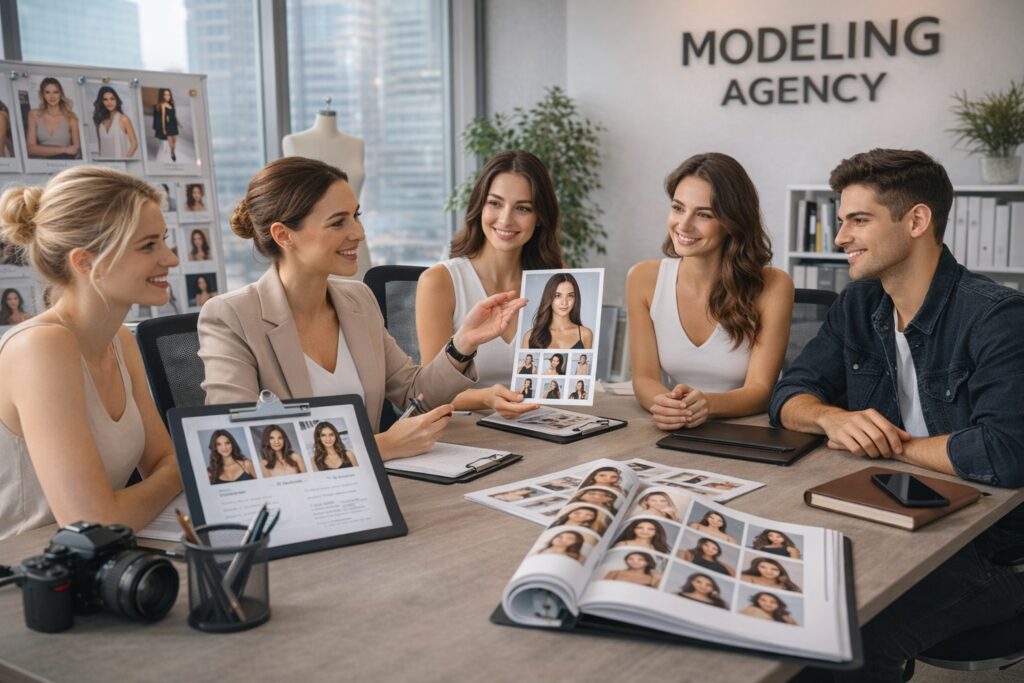
Modeling agencies can be incredibly valuable, but they’re also widely misunderstood. Let’s clear up what they actually do and whether you need one.
What Do Modeling Agencies Do?
Representation is the core function. When you sign with an agency, they represent you to potential clients. They market your look, submit you for jobs, and act as your professional face in the industry.
Negotiation is where agencies earn their commission. They negotiate your rates, usage terms, and contract details with clients. A good agent knows what rates are standard, what’s fair, and what to push back on. They also handle the paperwork and legal aspects of contracts.
Career development means guiding your career strategically. This includes advice on your portfolio, which jobs to take or pass on, when to change your look, and which markets to target. Experienced agents understand career arcs and can help you make choices that build long-term success rather than just taking every job that comes along.
Agencies also handle some of the business logistics that would otherwise fall on you: collecting payments from clients, dealing with late payments, maintaining your comp cards and online portfolios, and coordinating your schedule.
Legitimate modeling agencies make money only when you make money. They take a commission (typically 20% in the U.S., sometimes higher in other countries) from each job they book for you. They should never charge upfront fees for representation, portfolio development, or “registration.”
What Is a Mother Agent?
A mother agent is your primary or home agent, the one who discovered you and manages your overall career. The term comes from the idea of this agent being your “home base” while you potentially work with other agencies in different markets.
Mother agents focus on talent discovery and long-term career planning. They might scout a new model, develop them, help them build a portfolio, and then help place them with agencies in other cities or countries. For example, a mother agent in Chicago might help a model get started, then arrange for them to work with agencies in New York, Los Angeles, and internationally.
The mother agent typically receives a percentage of your earnings even when you’re working through other agencies, because they maintain the overall relationship and career guidance. This arrangement is most common with younger models being developed for the high-fashion market.
Not all models have or need a mother agent. This structure is more relevant for models pursuing international careers or high-fashion markets where you’ll work with multiple agencies around the world.
Do You Need an Agency to Be a Model?
Short answer: it depends on what type of modeling you want to do and where you live.
Agency modeling gives you access to higher-paying jobs, established clients, better legal protection, and career guidance. Major fashion and advertising clients typically work only with agencies, not with individual models directly. If you want to do runway work, major campaigns, or editorial for established publications, an agency is generally necessary.
The downsides include giving up 20% of your earnings, having less control over which jobs you take, and potentially waiting longer between jobs because your agency is prioritizing their entire roster, not just you.
Freelance modeling means finding and booking your own clients directly. This is increasingly viable, especially for commercial and social media modeling. You keep all your earnings, control your own schedule, and can choose exactly which jobs to take.
The downsides include having to handle all your own marketing, negotiations, contracts, and payment collection. You’ll also have a harder time accessing high-end clients who only work with agencies. And you need to be much more careful about scams and unsafe situations because you don’t have an agency vetting opportunities for you.
Many models do both: they’re signed with an agency for traditional work but also take on freelance projects for social media or local clients. Just make sure your agency contract allows this, as some agencies require exclusivity in their market.
Fashion Weeks & the Global Modeling Industry
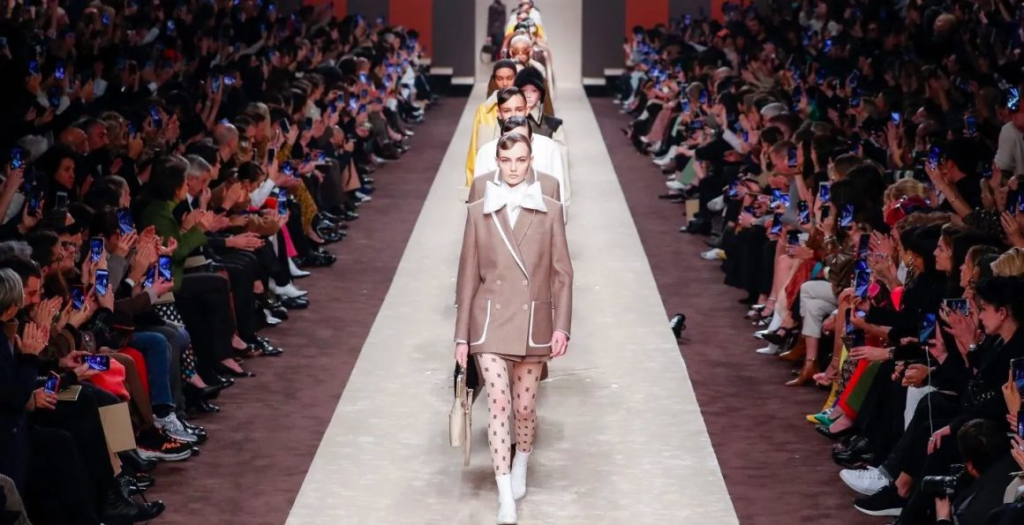
Image Credit: Amor Design Institute
Fashion weeks are the modeling industry’s biggest stages, where models, designers, and industry insiders converge to showcase and discover what’s next in fashion.
What Are Fashion Weeks?
Fashion weeks are industry events where designers present their upcoming collections to buyers, press, and industry professionals. They happen twice a year in major fashion capitals, showing fall/winter collections in February/March and spring/summer collections in September/October.
The purpose is both commercial and creative. Designers use fashion weeks to secure orders from retailers and generate press coverage. The shows themselves are theatrical presentations where clothing is shown on live models walking a runway.
For models, fashion weeks are intense periods where you might walk in multiple shows per day, attend countless castings, and potentially make important career connections in a short time span.
Major Global Fashion Weeks
New York Fashion Week is known for commercial wearability and American sportswear. It’s often considered the most accessible of the “Big Four” fashion weeks and has increasingly embraced diversity in casting.
Paris Fashion Week is the most prestigious, featuring the biggest luxury houses and haute couture. This is where high-fashion modeling careers are made. Walking shows for major Parisian houses is the pinnacle of runway modeling.
Milan Fashion Week showcases Italian luxury and craftsmanship. The casting tends to be more traditional and focused on classic beauty standards. Major Italian fashion houses show here.
London Fashion Week is known for avant-garde creativity and emerging designers. It’s smaller than the other three but respected for innovation and willingness to take risks.
Beyond these four, cities like Los Angeles, Tokyo, Sydney, Copenhagen, and many others host their own fashion weeks that are important for their regional markets and emerging designers.
Why Fashion Weeks Matter for Models
Career exposure is the biggest benefit. Being seen at fashion week by industry professionals can lead to other opportunities: campaigns, editorials, agency scouting from international markets, and recognition that elevates your career status.
Agency scouting happens intensively during fashion weeks. Agents from around the world attend specifically to discover new talent and see which models are trending. A strong fashion week season can result in multiple agencies wanting to represent you in different markets.
Portfolio growth from walking in established shows gives you credentials and tear sheets (published images) that strengthen your portfolio. Being able to say you walked for respected designers opens doors.
But it’s important to know that many models, especially those focused on commercial work, never walk in fashion week and still have successful, lucrative careers. Fashion week matters most if you’re pursuing high-fashion editorial and runway work.
How Models Make Money
Let’s talk about the actual money side of modeling, because this is where a lot of confusion and unrealistic expectations exist.
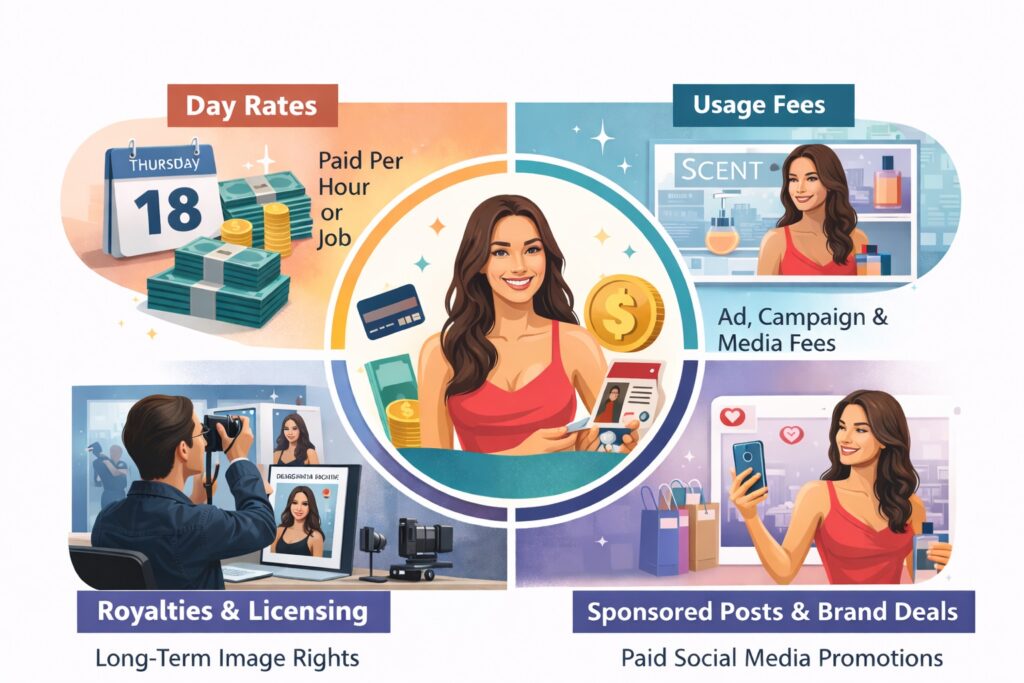
Day rates are what you’re paid for your time on a job. These vary wildly based on the type of work, your experience, the market you’re in, and the client’s budget. A local commercial shoot in a smaller city might pay $200-500 for a half day. A national advertising campaign might pay $2,000-5,000+ per day. Fashion show rates might be anywhere from nothing (for “exposure”) to several thousand dollars for established models.
New models typically start at lower rates and increase their fees as they build their portfolio and reputation. Your agency negotiates these rates on your behalf if you’re represented.
Usage fees are payments for how the client can use the images or footage created. This is separate from your day rate. A photo used only on a company’s website for three months is worth less than a photo used in a national magazine ad campaign for two years.
Usage is typically broken down by: medium (print, digital, TV, billboard, etc.), territory (local, regional, national, international), and duration (3 months, 1 year, 2 years, perpetuity). The broader the usage, the higher the fee. For major campaigns with extensive usage, the usage fees can exceed the day rate significantly.
Royalties and licensing come into play when images are used beyond the original agreement. If a client wants to extend usage or use images in ways not covered by the original contract, they need to negotiate and pay additional fees. This is more common with commercial and advertising work than editorial.
Social media collaborations have become a significant income stream for models with established followings. Brands pay models to create content featuring their products and share it with their audience. These deals might be flat fees ($500-5,000+ depending on your following and engagement) or ongoing relationships.
Long-term brand deals involve becoming the face of a brand for an extended period. These are the most lucrative opportunities and might involve being featured in multiple campaigns, representing the brand at events, and having exclusivity clauses. Major brand ambassadorships can pay six or seven figures annually for top models.
It’s important to understand that modeling income is inconsistent. You might book several jobs in one month and then nothing for two months. Most models don’t work every day or even every week. Building a sustainable income takes time and often requires diversifying across different types of modeling work.
Common Myths About the Modeling Industry
Let’s address some of the most persistent misconceptions that stop people from pursuing modeling or lead them to have unrealistic expectations.
“You must be tall to model” is only true for high-fashion runway work. The vast majority of modeling jobs have no height requirement. Commercial modeling, petite modeling, parts modeling, promotional modeling, and social media modeling don’t care how tall you are. Yes, you probably won’t walk in Paris Fashion Week if you’re 5’4″, but you can absolutely build a successful modeling career at any height.
“Modeling is easy money” is completely false. Modeling involves long hours standing under hot lights, holding uncomfortable poses, wearing painful shoes, working in extreme temperatures for location shoots, dealing with constant rejection at castings, irregular income, and maintaining your appearance as part of your job. The work itself might look easy in the final images, but getting those images is often physically and mentally demanding.
“Only young people can model” is outdated. While it’s true that the high-fashion runway world tends to skew young, commercial modeling needs all ages. The mature model market (40+, 50+, 60+) is growing as brands recognize that older consumers want to see people their age in advertising. Some models start their careers in their 30s, 40s, or even later.
“Agencies always charge upfront fees” is actually reversed: legitimate agencies should never charge upfront fees. Real modeling agencies make money when you make money by taking a commission from your bookings. If an “agency” wants you to pay for representation, training, photos, or registration before they’ll represent you, that’s a red flag. The exception is that agencies might arrange for you to work with specific photographers and then recoup those costs from your future earnings, but they shouldn’t demand money upfront before agreeing to represent you.
Risks, Challenges & Scams in Modeling
The modeling industry has legitimate opportunities, but it also has real risks. Being aware of them helps you protect yourself.
Fake agencies present themselves as legitimate modeling agencies but are actually fronts for selling expensive photo packages or “training programs.” They make money from aspiring models, not from booking real jobs. Warning signs include: pressuring you to pay upfront fees, guaranteeing you’ll get work, promising to make you famous, having no legitimate clients or successful models from their agency, and spending more time selling you services than discussing potential work.
Paid photoshoot scams involve “photographers” who want to shoot you but require you to pay them, often with promises that the photos will get you signed with agencies. Legitimate test shoots (where both model and photographer are building portfolios) should be collaborative and free for both parties. Professional jobs should pay you, not cost you money. Be especially wary of photographers who want to shoot you in private locations, pressure you to shoot alone without allowing you to bring someone, or suggest inappropriate clothing or poses.
Unsafe castings can put you in vulnerable situations. Red flags include: castings held in private residences or hotel rooms, requests to show more of your body than necessary for the job, being asked to come alone without allowing a chaperone, casting calls that don’t specify which company or brand is hiring, and anyone making you uncomfortable or asking inappropriate questions.
Contract red flags include: contracts that give away your image rights forever with no compensation, exclusivity clauses that prevent you from working with anyone else while paying you nothing, automatic renewal clauses that trap you in representation you want to leave, and usage terms that allow unlimited use of your images for minimal pay.
Always bring someone with you to castings and shoots when possible, especially when you’re starting out. Trust your instincts. If something feels wrong, leave. No job is worth compromising your safety. Research people and companies before working with them. Ask for references. Check their previous work and whether other models have had positive experiences with them.
How the Modeling Industry Is Changing
The modeling industry of today looks very different from even ten years ago, and it’s continuing to evolve rapidly.
Social media-driven modeling has fundamentally changed who gets opportunities. Instagram, TikTok, and other platforms allow models to build their own audiences and demonstrate their value to brands directly. Many models now get discovered through social media rather than traditional agency scouting. Brands increasingly want models who can create content, not just pose for it, and who bring their own engaged audience to collaborations.
This shift has democratized the industry in some ways. You can build a modeling career from anywhere if you can create compelling content and grow an audience. But it’s also added new pressures: models are expected to be content creators, photographers, editors, and marketers on top of the actual modeling work.
Diversity and inclusivity have improved significantly, though there’s still progress to be made. The industry is featuring more models of different races, body types, ages, gender identities, and abilities than ever before. This change has been driven by both social pressure and the business reality that diverse representation sells products to diverse consumers.
Plus-size modeling is no longer niche. Mature models are getting major campaigns. Brands are actively seeking models with disabilities. Conventional beauty standards are expanding to include looks that would have been considered “unconventional” in previous decades.
Digital and AI-generated models are emerging as a genuine category. Some campaigns now feature entirely digital models created by computers. Virtual influencers have millions of followers. AI can now generate photorealistic images of people who don’t exist. This technology is controversial and raises questions about the future of traditional modeling work, but it’s happening and will likely continue to develop.
Remote castings and virtual shoots became necessary during COVID-19 and have remained common because they’re more efficient. Many castings now happen via self-tape submissions. Some clients book models based entirely on portfolio reviews without in-person meetings. Technology allows for remote direction of photoshoots where the creative team and model aren’t in the same location.
These changes mean today’s aspiring models need different skills than previous generations. You need to be comfortable with technology, capable of self-direction, able to create content independently, and adaptable to rapid industry changes.
Is the Modeling Industry Worth It?
This is the question you’re probably really asking yourself. Should you actually pursue modeling? Here’s an honest assessment.
Pros of a modeling career include: flexible scheduling (you control which jobs you take), creative work (if you enjoy visual arts and fashion), travel opportunities (especially at higher levels), networking with interesting people in creative industries, building confidence and presentation skills, and the potential for high earnings if you’re successful.
For some people, modeling is also just fun. If you enjoy being in front of the camera, collaborating on creative projects, and the energy of photoshoots, that matters even if you’re not making a fortune.
Cons and realities include: inconsistent income (especially when starting), constant rejection (you’ll be turned down for most castings you attend), physical demands (long hours, uncomfortable conditions, maintaining your appearance), age and appearance pressure (your look is literally your product), lack of job security or benefits (most models are freelance with no health insurance, retirement, or paid time off), and potential exploitation (scams and unsafe situations exist).
The financial reality is that most models don’t make enough from modeling alone to support themselves, especially when starting. Many models have other jobs or sources of income. The few who reach high earnings are a small percentage of everyone trying to model.
Who should seriously consider modeling: people who already get approached regularly about modeling or told they have a unique look, people who enjoy being in front of the camera and find the work itself fulfilling, people who can handle rejection and inconsistency without it crushing them emotionally or financially, people willing to treat it as a business and learn the industry professionally, and people who have realistic expectations about earnings and success timelines.
Who may want to explore related fields: if you’re attracted to the creative and fashion aspects but don’t necessarily want to be in front of the camera, consider photography, styling, creative direction, fashion design, or content creation. If you want the visibility and influence part, consider social media content creation or influencer work directly. If you want flexible creative work with more consistent income, consider related fields like acting, voice work, or behind-the-scenes creative roles.
Modeling can absolutely be worth it, but “worth it” means different things to different people. For some, a successful modeling career means making six figures and traveling internationally. For others, it means earning a few hundred dollars a month doing something they enjoy while pursuing other goals. Both are valid.
Frequently Asked Questions About the Modeling Industry
Is modeling a real career?
Yes, modeling is a legitimate career, but it works differently than traditional employment. Models are typically freelancers who book individual jobs rather than having a steady employer and paycheck. Some models make significant long-term income from modeling, while others do it part-time or as supplementary income. Like other creative and freelance fields, success varies widely, and financial stability takes time to build.
Can beginners enter the modeling industry?
Absolutely. Everyone starts somewhere, and many successful models had zero experience when they began. What matters is having a look that’s currently in demand, professional attitude, willingness to learn, and either signing with a legitimate agency or building your own opportunities through networking and social media. Starting with local opportunities and smaller clients helps you gain experience and build a portfolio.
How long does a modeling career last?
This varies dramatically based on the type of modeling. High-fashion runway models often have shorter career peaks, sometimes just a few years in their late teens and early twenties, though some extend this much longer. Commercial models often work well into their 30s, 40s, 50s, and beyond because advertising needs to represent all ages. Some models transition into related careers (acting, creative direction, agency work) as they age. There’s no single timeline.
Do models get paid monthly or per job?
Models are paid per job, not monthly salaries. After completing a job, payment typically comes 30-90 days later (sometimes longer for international work). This is processed through your agency if you’re represented, with the agency taking their commission before paying you. The inconsistent payment schedule is one of the challenges of modeling. Some months you might get paid for multiple jobs, and other months nothing. Budgeting and saving during good periods is essential.
Is modeling safe?
Modeling can be safe if you’re informed and cautious, but like any industry, it has risks. Legitimate professional modeling with established agencies and clients is generally safe. The risks come from predatory individuals posing as industry professionals, inappropriate photographers, fake agencies, and unsafe working conditions. You can protect yourself by: researching people before working with them, bringing a chaperone to castings and shoots, never paying upfront fees to agencies, trusting your instincts when something feels wrong, and working with established agencies and clients when possible. Many models work their entire careers without serious problems, but awareness and caution are important.
Final Thoughts
The modeling industry is more accessible and diverse than ever, but it’s also more complex than most people realize from the outside. It’s not just about being attractive or tall. It’s about understanding the business, knowing which opportunities to pursue for your specific look and goals, protecting yourself from scams and exploitation, and building professional relationships.
If you’re considering modeling, start by being honest about what you want from it. Are you interested in high-fashion runway work, or would commercial modeling suit you better? Are you willing to move to a major modeling market, or do you want to work locally? Do you want this to be a primary income source, or a side project? Your answers will shape how you approach the industry.
Keep learning. The modeling world changes quickly, and what worked five years ago might not work now. Follow industry trends, study models whose careers you admire, and understand that building success takes time and persistence.
Most importantly, treat modeling as a business. Keep records, save money during good periods, protect your image rights, read contracts carefully, and don’t let the creative aspects make you forget this is work that should be fairly compensated.
The modeling industry has real opportunities for people willing to approach it professionally and realistically. Whether you end up walking international runways, appearing in local commercials, building a freelance career through social media, or discovering that modeling isn’t for you after all, understanding how the industry actually works gives you the foundation to make informed decisions about your own path.
Continue exploring the related guides on this site to dive deeper into specific aspects of modeling, from how to build your portfolio to understanding modeling contracts, avoiding scams, and learning what different types of modeling involve. Your modeling education is just beginning.
Leave a Reply