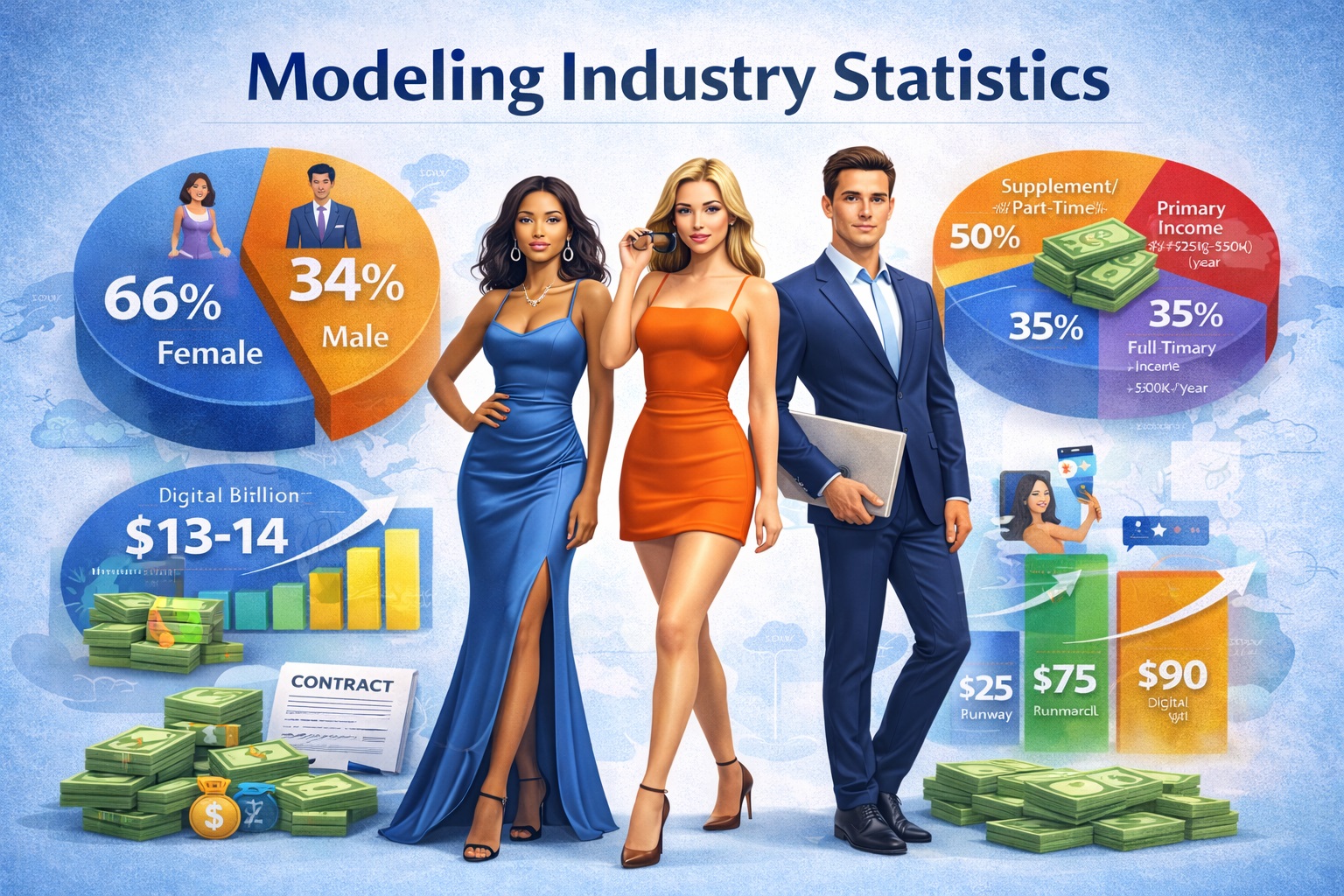
The modeling industry is often viewed through the lens of fashion weeks, luxury campaigns, and celebrity supermodels. In reality, it is a complex global business that sits at the intersection of fashion, advertising, media, and technology. From runway and editorial modeling to commercial, e-commerce, and influencer-led campaigns, modeling has evolved into a multi-billion-dollar industry with diverse income streams and career paths.
In 2025–2026, the modeling industry is being reshaped by digital commerce, social media influence, changing beauty standards, and the rise of freelance and independent talent. Understanding modeling industry statistics helps aspiring models set realistic expectations, agencies adapt to market demand, and brands make informed casting and marketing decisions.
This article breaks down the latest modeling industry data, including market size, earnings, demographics, diversity trends, geographic hotspots, and where the industry is headed next.
Key Modeling Industry Statistics
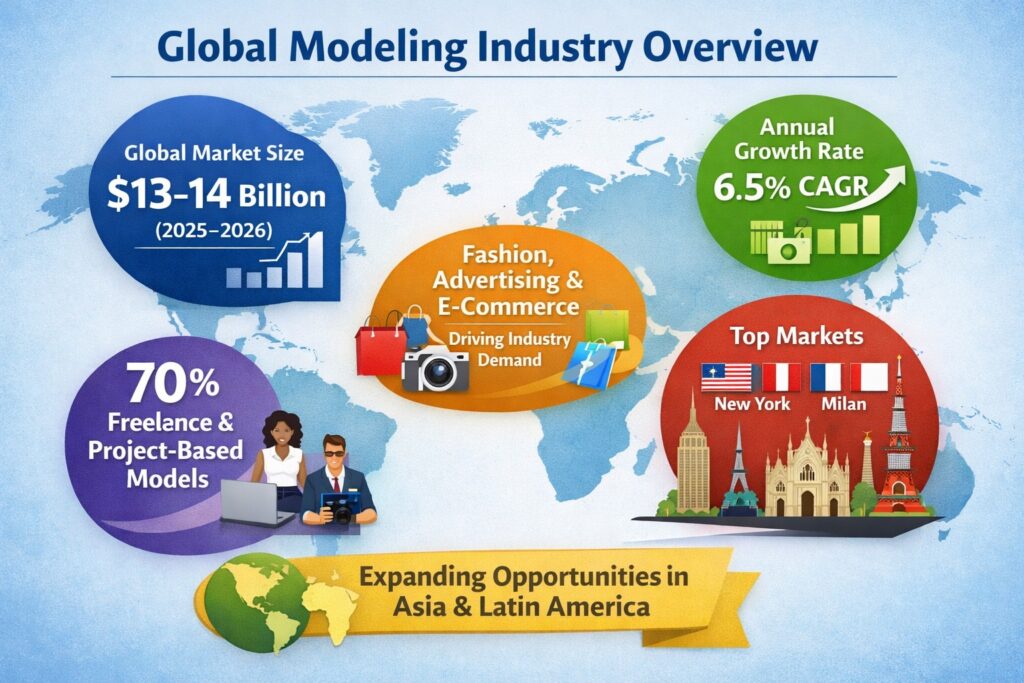
Global market value: The modeling industry is estimated to be worth USD 13–14 billion, driven mainly by commercial advertising, digital campaigns, and e-commerce.
Freelance dominance: Around 70% of models work freelance or project-based, rather than under exclusive long-term contracts.
Earning reality: While top models earn millions, most working models earn modest, irregular incomes, often combining modeling with other work.
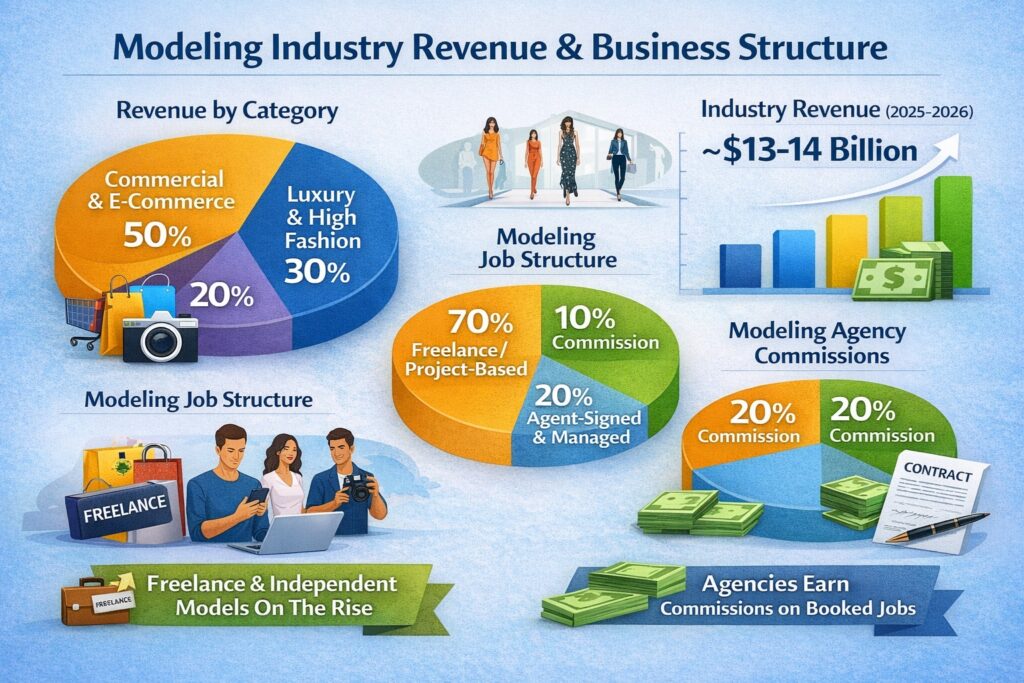
Agency commissions: Standard agency commissions range between 10–20% per booking, depending on region and representation level.
Fastest-growing segment: Commercial, lifestyle, and e-commerce modeling now generate more jobs than runway and editorial combined.
Digital influence: Social media presence influences casting decisions for over half of brand campaigns.
Geographic concentration: The majority of high-fashion work remains concentrated in New York, Paris, Milan, and London, with rapid growth in Asia.
Global Modeling Industry Overview
Market Size and Economic Role
The modeling industry forms a small but critical part of the wider global fashion and advertising economy. While fashion itself generates trillions in global revenue, modeling acts as the visual engine that drives consumer engagement, branding, and sales.
In 2025–2026, growth is being fueled less by traditional runway shows and more by:
- Online retail and e-commerce imagery
- Social media advertising
- Global brand localisation campaigns
- Influencer-led content and UGC-style visuals
As brands shift marketing budgets from print to digital, the demand for models who can work across photo, video, and social platforms continues to rise.
Modeling Industry Revenue & Business Structure
Where the Money Comes From
Most modeling revenue today comes from commercial and brand-driven work, not high fashion. This includes:
- E-commerce product shoots
- Lifestyle and advertising campaigns
- Beauty, fitness, and wellness brands
- Regional and local brand promotions
Runway and editorial modeling still carry prestige, but they account for a smaller share of total industry revenue. Many runway shows pay little or nothing, especially for new models, while commercial jobs often offer more consistent pay.
Agency vs Independent Models
Agencies remain central to the industry, but the rise of freelance and independent models has changed the landscape. Many models now:
- Sign with non-exclusive agencies
- Negotiate direct brand deals
- Use social media as a lead-generation tool
This shift has reduced reliance on traditional agency pipelines while increasing competition.
Model Earnings & Income Statistics
Average Earnings
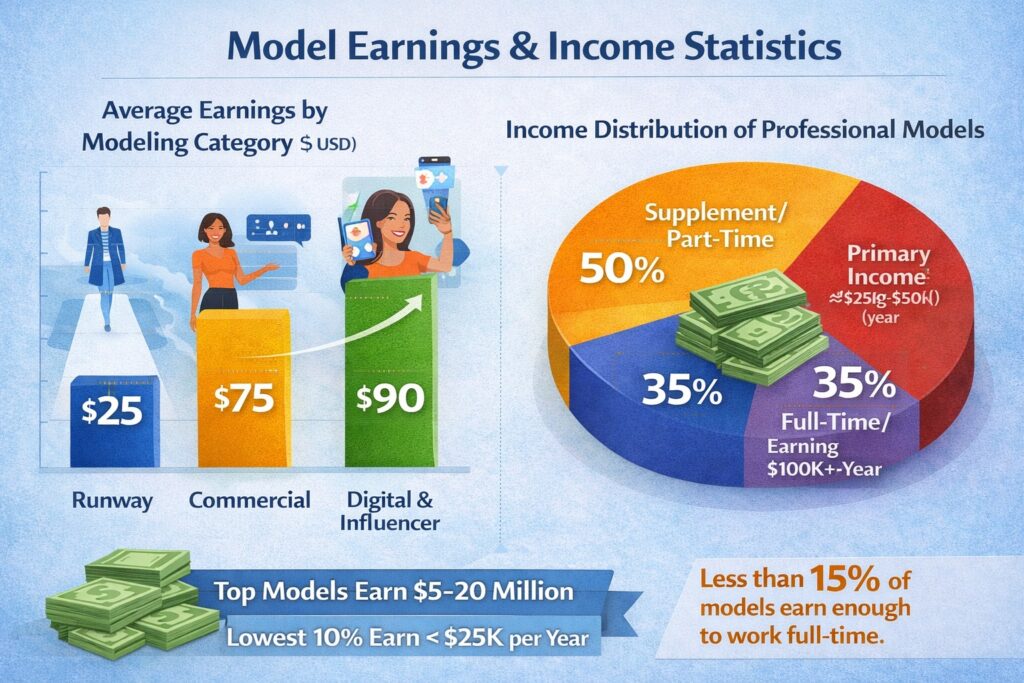
Model earnings vary dramatically depending on location, experience, and category:
- Commercial models often earn steady mid-range income
- Runway and editorial models may earn very little early in their careers
- Influencer-model hybrids can outperform traditional models financially
Hourly and per-day rates may look high on paper, but irregular bookings mean annual income is often unpredictable.
Income Inequality in Modeling
One of the most important modeling industry statistics is income distribution:
- A small percentage of top models earn the majority of industry income
- Most working models earn supplemental or part-time income
- Fewer than 15% rely solely on modeling as full-time work
This reality is often misunderstood by newcomers entering the industry.
Gender, Age & Demographics
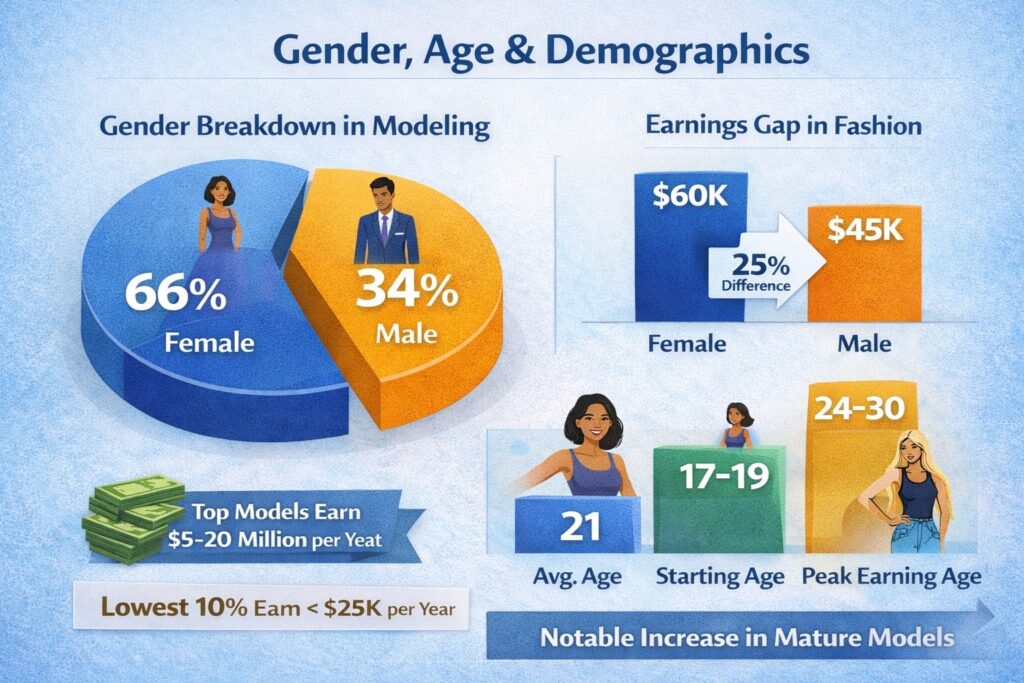
Gender Breakdown
Female models still dominate fashion modeling, particularly in beauty, runway, and editorial work. However:
- Male modeling demand is growing in lifestyle and fitness categories
- Non-binary and gender-fluid models are increasingly visible in advertising
- Commercial work shows more gender balance than high fashion
Age Range
While high fashion favors youth, the broader industry is far more inclusive:
- Fashion runway models often start young
- Commercial models work across wide age ranges, from children to seniors
- Mature models are in growing demand for finance, healthcare, and lifestyle brands
Diversity & Representation Statistics
Body Diversity
Despite public commitments to inclusivity, data from fashion weeks shows that straight-size models continue to dominate runway casting. Progress has been uneven, with commercial advertising leading the way in size inclusivity, while high fashion lags behind.
Ethnic and Cultural Representation
Representation has improved over the past decade, particularly in global advertising campaigns. However:
- Inclusion often varies by season and region
- True diversity is more visible in commercial work than luxury runway shows
Brands increasingly recognise that diverse casting reflects real consumers and improves engagement.
Modeling Categories by Demand

Demand in the modeling industry is now clearly segmented:
- Commercial & lifestyle modeling: Highest job volume
- E-commerce modeling: Fastest-growing category
- Editorial modeling: Prestige-focused, limited pay
- Runway modeling: Highly competitive, limited slots
For most working models, commercial and digital work forms the backbone of their income.
Geographic Distribution of Modeling Jobs
The industry remains geographically concentrated:
- New York, Paris, Milan, London dominate high fashion
- Asia-Pacific markets are expanding rapidly
- Regional markets now support full-time commercial modeling careers
Models no longer need to relocate internationally to work consistently, especially in commercial niches.
Social Media & Digital Influence
Social platforms have transformed modeling:
- Models are often cast for reach as well as appearance
- Engagement rates can matter more than follower count
- Content creation is now part of many modeling contracts
The line between model, influencer, and creator continues to blur.
Modeling Agencies Today
Traditional agencies are adapting by offering:
- Social media management
- Brand strategy support
- Global placements
Boutique agencies and niche representation are becoming increasingly popular.
Technology & Future Trends
Key developments shaping the future:
- AI-generated and virtual models
- Digital casting platforms
- Remote shoots and virtual fittings
Technology is changing how models are discovered, booked, and paid.
Conclusion
The modeling industry in 2025–2026 is larger, more digital, and more diverse than ever — but also more competitive and unequal. While opportunities have expanded beyond runways and fashion capitals, success now requires adaptability, digital skills, and realistic expectations.
For aspiring models, agencies, and brands, understanding modeling industry statistics is essential to navigating this evolving global marketplace.
Sources:
https://www.statista.com/topics/793/apparel-market-worldwide/
https://www.statista.com/statistics/272015/global-apparel-market-size-by-region/
https://www.verifiedmarketresearch.com/product/modeling-agency-market/
https://www.grandviewresearch.com/industry-analysis/fashion-apparel-markethttps://www.bls.gov/ooh/entertainment-and-sports/models.htm
https://www.ziprecruiter.com/Salaries/Model-Salary
https://www.payscale.com/research/US/Job=Model/Salaryhttps://models.com/rankings/ui-openings
https://models.com/models
https://www.voguebusiness.com/fashion/the-vogue-business-spring-summer-2026-size-inclusivity-report
https://www.businessoffashion.com/articles/workplace-talent/how-models-actually-make-money/https://www.thefashionspot.com/runway-news/
https://cfda.com/resources
https://www.britishfashioncouncil.co.uk/business-supporthttps://hypeauditor.com/blog/influencer-marketing-statistics/
https://influencermarketinghub.com/influencer-marketing-benchmark-report/
Leave a Reply